











2026 GTAP Modeling Trade Policy (MTP) Course
Online
Online courses
Part Time
Regular fees: 550 - 2190 USD
Enrollment Fees
- $2,190 Professional (Developed Country)
- $1,645 Professional (Developing Country)
- $1,095 Student (Developed Country)
- $550 Student (Developing Country)
OPEN
Ginger Batta
Enroll in the GTAP Modeling Trade Policy (MTP) Course to learn to model and quantify the impact of tariffs, non-tariff measures, and global policy shocks in a shifting trade landscape!
2026 GTAP Modeling Trade Policy (MTP) Course
"Applied Analysis on Trade Policy Instruments"
General Information
Course Dates: October 12 – November 29, 2026
Application Deadline: July 26, 2026
Location
GTAP MTP is delivered fully online. There is no onsite component to this course.
Offered by
Center for Global Trade Analysis, Purdue University
Enrollment Fees
- $2,190 Professional (Developed Country)
- $1,645 Professional (Developing Country)
- $1,095 Student (Developed Country)
$550 Student (Developing Country)
Why You Should Apply
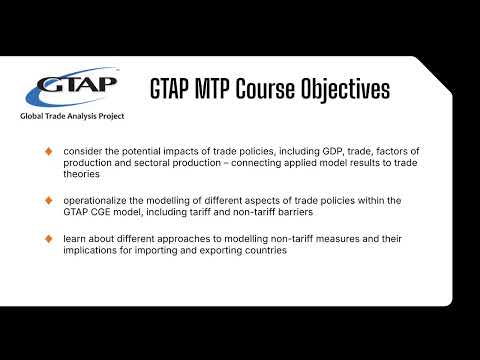
- Model and Quantify the Impact of Tariffs, Non-Tariff Measures, and Global Policy Shocks in a Shifting Trade Landscape!
- Master Trade Policy Analysis using GTAP - Trade policy is again a central driver of macroeconomic risk and opportunity. Today's trade environment features policy moves that restructure trade blocks via tariff escalations and NTMs. In this course, you will gain practical, applied experience designing and running policy scenarios covering tariffs, non-tariff measures, and global policy shocks. This course equips you to produce transparent economy-wide analysis of these policies using the standard GTAP Model and RunGTAP suite.
- Translate Trade Shocks into Macro and Sectoral Policy Impacts - Bridge the gap between high-level trade theory and sectoral policy results. You will learn to assess how trade shocks ripple through the economy, affecting GDP, bilateral trade flows, factor returns, and sectoral production in addition to other metrics required in reports by government institutions, international organizations, and economic consultancies.
- Decode the Complexity of NTMs - NTMs increasingly shape market access, but their effects are difficult to observe and implement. This course provides a practical framework for representing NTMs within GTAP-based experiments. You will learn multiple approaches to incorporating and modeling NTMs and evaluate how alternative modeling choices affect results and policy conclusions.
- Collaborate on a Guided Research Project - Apply everything you learn in a team-based research project, developing your own shocks and policy questions with feedback from experienced GTAP-U instructors. These components will provide invaluable experience for those preparing internal policy notes, consultancy deliverables, or journal submissions.
- Strengthen Career and Academic Credentials - Whether you work in government, international institutions, or academia, GTAP proficiency is widely recognized as a mark of technical authority in economy-wide policy analysis. This course provides a specialized, applied toolkit that supports both policy-relevant work and academic research in trade. Delivered in a flexible, high-quality online format, the program is designed for working professionals, and combines structured modules, guided exercises, and clear milestones that fit alongside policy cycles, research deadlines, and institutional responsibilities.
Course Content
Trade policy is increasingly used as a strategic instrument to advance a wide range of national objectives, not only market access and competitiveness, but also supply security, resilience, strategic industries, and broader national interest goals. Governments face overlapping priorities such as managing trade imbalances, responding to shocks, and designing targeted tariff and non-tariff measures (NTMs) that align with domestic policy constraints and international commitments.
The GTAP Modeling Trade Policy (MTP) Course is designed to provide professionals and students with hands-on, applied training in the analysis of modern trade policy using the GTAP computable general equilibrium model (version 7). The course provides participants with an opportunity to develop practical skills in the design of policy experiments, the implementation of changes in tariff and non-tariff barriers, and the interpretation of model results for policy-relevant insights. The curriculum emphasizes an intuitive treatment of core economic theory, and provides structured, guided experience in running the standard GTAP Model within the RunGTAP software environment. Learning culminates in team-based research projects in which participants frame a real-world policy question, implement the relevant tariff and NTM scenarios, and communicate results in a way that supports decision-making. By the end of the course, participants will have strengthened their applied capacity to assess the economy-wide and sectoral implications of tariff and non-tariff policy options, including preferential trade agreement- style (PTA) liberalization scenarios or tariff hikes where relevant, within a broader trade policy context.
Course Structure
The course is delivered fully online and supported by the textbook, Introduction to Computable General Equilibrium Models, 3e, the eBook version of which, as well as all other necessary course software and materials, will be provided to participants. Since participants will be located all around the world, there are no set meeting times for the course, but instructors may schedule periodic, online check-in sessions as needed. Learning and communication take place through active discussions among the participants and instructors, which are carried out as asynchronous, threaded conversations on the classroom bulletin board, and through virtual team work on collaborative projects and online meetings facilitated by the instructors.
Content Overview
- Week 1 - "Getting Started"
- Week 2 - "Analysis of trade policies and Tariffs"
- Week 3 - "NTMs in GTAP"
- Weeks 4 - "New Approaches"
- Weeks 5-6 - "Group Research Project"
- Week 7 - "Wrap-Up and Evaluation"
Time Commitment
Participants should expect to spend approximately 10-12 hours per module on this course.
Prerequisites
Participants are expected to have completed the GTAP 101 Course and/or GTAP Short Course, or have working experience with the standard GTAP Model prior to application.
Application
Individuals interested in taking this course must apply on the GTAP website. Applications will be reviewed after the deadline and those individuals accepted will receive an email detailing how to register and submit payment. Please note that application does not guarantee acceptance.
403 Mitch Daniels Blvd.
47907-2056 West Lafayette , Estados Unidos

