









Study Advice
Discovering Graduate Economics Through a Summer School
Read a summary using the INOMICS AI tool
If you are an undergraduate student of economics, the prospect of a Master’s, MRes or PhD can feel hard to picture. You might be wondering what the pace is like, how mathematical the first term really is, and what “graduate-level” expectations look like day to day.
One practical way to find out is to take part in a summer school designed specifically as a bridge into postgraduate study. These courses introduce more advanced methods than most undergraduate programmes cover in depth, and they help you identify what to strengthen before you apply.
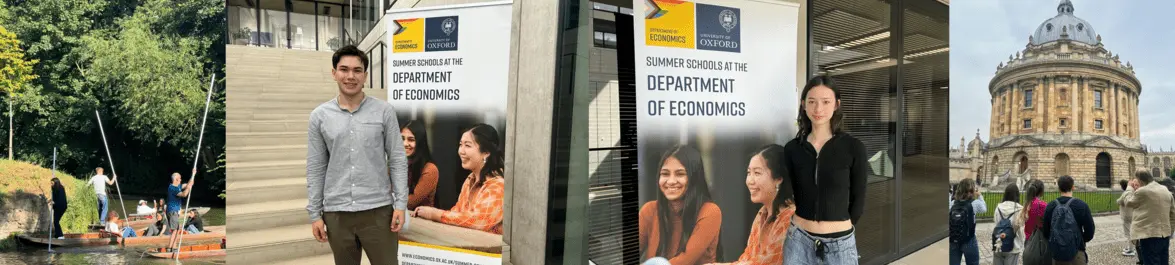
In 2024 and 2025, two undergraduates, Ellen Lac (University of Edinburgh) and Jem Grimley (University of Warwick), attended the Fundamentals of Graduate Economics & Finance summer school run by the University of Oxford’s Department of Economics. Here is what they found most valuable.
At a glance
• What it is: a one-week intensive introduction to core graduate foundations
• What you study: mathematical analysis and econometrics, supported by seminars and problem-solving
• Who it suits: undergraduates preparing for postgraduate economics, and early-stage graduates who want to strengthen quantitative foundations
• What you gain: a clearer sense of graduate expectations, plus a cohort network and insight sessions on pathways in economics
Before the course: preparation that pays off
 |
Both Ellen and Jem emphasised the value of the preparatory reading provided in advance. With a structured reading list, students can bridge gaps in knowledge and arrive ready to engage with more advanced concepts.
• Jem found the materials especially helpful for consolidating what he already knew, and for identifying areas to revise before teaching began.
• Ellen felt the preparation helped bring students from different academic backgrounds onto a shared footing.
If you are considering the course, the message from both students is simple: do the preparation. It makes the first few days far more manageable.
The academic core: building the toolkit
The week is designed to introduce the foundations many students encounter early in postgraduate economics. Teaching focuses on both conceptual understanding and how to apply tools under time pressure.
Mathematical analysis
The first half of the course focuses on mathematical analysis, taught by Professor Ines Moreno de Barreda.
Jem described this part as demanding at first, and said it pushed him to build “resilience” as the pace accelerated. Ellen, whose degree had not included dedicated maths modules for economics, found that the teaching helped her get comfortable with abstract ideas more quickly than she expected.
Both students highlighted the same takeaway: this material is not just theoretical. It is the foundation you rely on when graduate economics becomes more technical.
Econometrics
The second half of the course moves into econometrics, taught by Professor James Duffy.
Jem appreciated how the teaching used practical examples to ground the techniques in real-world questions. Ellen noted that econometrics is central to postgraduate study, particularly when it comes to reading research critically and producing dissertation work that stands up to scrutiny.
Both also pointed to the value of the seminar structure. Having space to ask questions, test understanding, and work through problems interactively helped them build confidence quickly.
Insight sessions: pathways, applications and confidence
Alongside the academic programme, Ellen and Jem both highlighted the “insight sessions”, where participants meet current and former postgraduate students and professionals working in economics-related roles.
Ellen found these sessions especially useful because they made the range of possible pathways feel concrete. Hearing directly from people at different stages helped her picture what she might want next, and what preparation would be most valuable.
The cohort experience: learning with people who take it seriously

|

Both students spoke warmly about the social side of the week, not as a separate extra, but as part of what makes the experience work. A one-week intensive course is easier when you have a group around you who are tackling the same material and comparing notes.
From informal meet-ups early in the week to college dinners later on, the schedule creates space to connect. Ellen also highlighted punting as a memorable moment to slow down and reflect on how much they had covered in a short time.
The broader point is simple: if you are considering postgraduate economics, building a peer network can matter almost as much as the content.
What they took away
By the end of the week, both Ellen and Jem described leaving with clearer direction and more confidence.
• Jem felt more prepared to tackle econometrics, and more realistic about what it would take to succeed at postgraduate level.
• Ellen described a renewed determination to push her academic boundaries, and a clearer sense of what graduate study might involve.
Both would recommend the summer school to students who want an honest preview of graduate economics, and who are ready for an intensive week that rewards effort. In closing, Jem and Ellen invite others to seize this opportunity, urging, “If you can see yourself enjoying this or wanting to challenge yourself academically, you should apply. You’ll leave with not just knowledge but an inspiration that lasts a lifetime.”
About the students
Ellen Lac is an undergraduate economics student at the University of Edinburgh and former Vice-President of the University of Edinburgh Economics Society. She took part in the Fundamentals of Graduate Economics & Finance summer school in 2024. Read Ellen’s full Student Diary entry.
Jem Grimley is an undergraduate economics student at the University of Warwick. He took part in the Fundamentals of Graduate Economics & Finance summer school in 2025. Read Jem’s full Participant Reflection.
|

|

Sponsored Content: This article was written by the INOMICS team, in partnership with the University of Oxford’s Department of Economics, based on Student Diary posts. The article has been reviewed by the INOMICS editorial team, and meets our publishing standards. INOMICS only publishes articles that we consider to be of value to INOMICS users.
Image Credits: Oxford University Economics Summer Schools
-
- Mid-Level Industry Job
- Posted 1 week ago
Lead Economist, Editorial
At Wealthfront in États-Unis
-
- Research/Project Funding Opportunity
- Posted 2 weeks ago
Call for Research Projects 2026 “Women and Science”
at Université Paris Dauphine-PSL in France -
- Programme de Doctorat
- Posted 6 days ago
International PhD in Economics in Japan. Coursework conducted entirely in English. Scholarships available.
Starts 1 Oct at Yokohama National University, Department of Economics in Yokohama, Japon
Currently trending in États-Unis


Related Items



Featured Announcements


Échéances à venir
- oct 09, 2026
- oct 12, 2026
- oct 12, 2026
- oct 12, 2026
- oct 14, 2026

