









Why study Economics in a Foreign Language?
Read a summary using the INOMICS AI tool
With English being considered the “must-have language”, is there a need for economists to learn a foreign language, or does it concern only those who work or want to work in the business field in a non-English speaking country?
While gaining proficiency in English remains the priority, economists` regard toward languages is changing. Progressive Economics explains in its article Language Economics: Why Santorum’s Argument Doesn’t Translate that globalization has driven economists´ attention not only to the increased flow of goods, but also to the increased flow of migration and the cultures and languages that comprise them.
No matter which foreign language one chooses to learn, researchers at the University of Chicago have proven that economists benefit from studying in a non-native tongue. Their research shows that thinking through a problem in a foreign language helps one to make more rational decisions. Learning a foreign language teaches one to reduce emotional involvement and thus increases the likelihood of taking favorable risks. This is credited to a ‘’distancing mechanism” created during the learning process. Peter Cullen, expert in Content and Language Integrated Learning (CLIL) and lecturer at the University of Urbino, commented on the power of this ability, explaining how learning a second language allows the brain to benefit from a duality and improves the process of thought itself, which is „particularly important given that none of our economies really function in entirely mono-lingual contexts“. He defined the current global economy as an “integrated system of connected localities, regionalities and national-supernationalities which functions across many languages and their respective formal and informal institutional cultures.”
With over 6700 spoken languages, which ones should economists study? Russian, Chinese and Arabic, though rising in popularity, can seem too difficult to learn for some, but a reignited interest emerging among economists for European languages, especially Spanish, French and German, has led to the creation of some hybrid programs all over the world. The aim of programs such as the IEML (International Economics and Modern Languages), the FLIE (Foreign Language and International Economics) or the BSc Economics With A European Language is to combine the main elements of a degree in economics with language and cultural skills to allow students to gain edge in the global economy. These interdisciplinary studies might thus shape the new profile of multilingual economists.
If you are thinking that learning a new language is too challenging for you, keep in mind some tips from the Modern Language Association (MLA):
- You are never too young and it is never too late to begin to learn a new language!
- Whatever language you choose, learning it will make a difference in how you see the world and in how the world sees you!
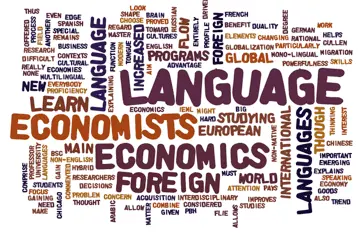
Image Credits: INOMICS - Custom Word Cloud
-
- Conferenza
- Posted 3 weeks ago
49th RSEP International Conference on Economics, Finance and Business
Between 18 Nov and 20 Nov in New York City, Stati Uniti
-
- Programma di Dottorato
- Posted 3 hours ago
PhD in Economics and PhD in Finance at Durham University
Starts 1 Oct at Durham University in Durham, Regno Unito
-
- Scholarship, Postdoc Job, Postgraduate Scholarship
- Posted 6 days ago
Postdoctoral scholarship (3 years) in Economics
At Umeå School of Business and Economics, Umeå University in Umeå, Svezia
Currently trending in Stati Uniti


Related Items



Featured Announcements


Prossime Scadenze
- Ott 09, 2026
- Ott 12, 2026
- Ott 12, 2026
- Ott 12, 2026
- Ott 14, 2026

