Teaching Resources
The COP Negotiations Game: Experiential Learning and Education for Sustainable Development
Read a summary using the INOMICS AI tool
Introduction
The COP Negotiations Game is an interactive, role-playing game to simulate climate change negotiations with students in class. The game builds on standard models of public goods, which I embed into a simple dynamic model of climate change. Students act as countries, negotiating and strategically implementing climate change policy under shared climate risks.
The game brings together two strands of teaching innovation I care about. First, the use of in-class experiments to support active learning of abstract microeconomic models. Second, the integration of Education for Sustainable Development (ESD) elements into economic modules. The game integrates ESD by leveraging existing content in economics that speaks quite directly to environmental issues and climate change, without radically departing from it (Economics Network, 2023).
The COP Negotiations Game: structure and mechanics
The game can be played in a two-hour session, with enough time for a post-game debrief.
• Students are split into 4 or 5 groups. Each group represents an abstract country.
• The game has three rounds. Each country starts with a £200 million budget and the goal is to finish the game with as much money left as possible.
• A common pool of emissions accumulates in the atmosphere over rounds and periodically generates some climate change-related monetary damage for the countries.
At the start of the game, players receive a set of cards from a main deck, which represent costly investment against climate change, and include mitigation and adaptation cards.
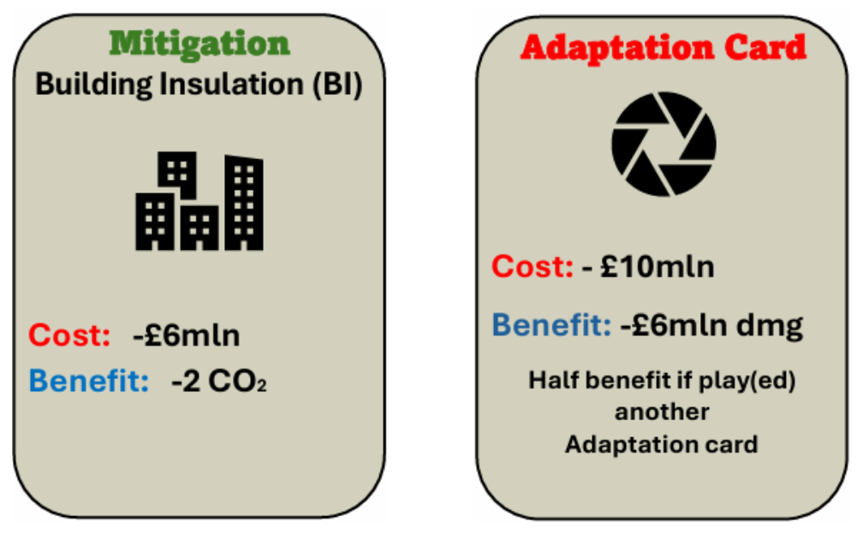
Figure 1: Example mitigation and adaptation card.
In each round, there are two stages:
• Negotiations and Implementation. Players study their cards, can trade and negotiate with one another, and then secretly choose which cards to play.
• Climate Change Monetary Damage. Total emissions for the round and the resulting stock of emissions in the atmosphere at the end of the round are calculated.
Then, climate change monetary damage is computed and assigned to each country.
Main Insight and Objective
Mitigation cards capture individual public-good contributions and are the core of the game. When a country plays a mitigation card, it generates a positive externality: by reducing the common pool of emissions, it also lowers the future monetary damage for other countries. The social benefits of mitigation are greater than the individual, private ones.
This is exactly the set-up and main insight of standard public goods games. Purely self- interested players ignore the positive externality. Consequently, the many mitigation investments that would be worthwhile for society as a whole do not look worthwhile from an individual player’s perspective, which results in the classic market failure of too little mitigation.
This is the core message of the game, which can be made concrete to students in the debrief by making simple calculations based on the cost and benefit values on the cards. At the same time, another important message is that such an inefficient outcome does not necessarily have to arise. Negotiations exist precisely to give players a chance to find a way out of this gridlock. Players can propose deals such as “I will play these cards if you play those cards too”. Doing so, they may realize that coordinated action leaves everyone better off, even though each individual player has a temptation to free-ride at the last moment, which is a tension relevant to climate change negotiations.
Richer Features and Reflection
The basic public-good mechanism only constitutes the skeleton of the game. The design has additional features that allow for a richer interaction and reflection in the debrief. First, adaptation cards introduce another important dimension. Instead of reducing emissions, these allow a country to invest in measures that reduce its own climate change damage directly. This gives players a “self-protection” option as well as mitigation, which raises interesting strategic considerations. For example, adaptation might make players less inclined to cooperate on mitigation.
Second, I introduce relationships across mitigation cards. Some are complements (e.g. electric vehicles and charging infrastructure), others act more like substitutes (e.g. different sources of renewable energy, such as wind and solar), and some become effective only if another “activation” card is played (e.g., electric battery technology for electric transportation). This adds strategic complexity and reflects real features of climate policy, such as the need for supporting infrastructure or for a specific sequence of investments. It also gives players a strong reason to talk to one another, compare cards and coordinate their strategies, rather than acting in isolation.
Because of these elements, the game is more than a one-dimensional exercise. The core learning outcome is the public-good mechanism, but there are other interesting aspects that make the game a bit more complex but also richer and more engaging. This can invite reflection in terms of game theory and strategic incentives but also in connection to the actual climate policies that are displayed on the cards.
Reproducibility
I have invested substantial time to make my COP Negotiations Game practical to run within a two-hour session. I have produced:
• A concise set of slides to introduce the game in a comprehensive but brief way to the participants.
• A card handbook, which describes the various cards and the relationships across them graphically through “card trees”. I distribute a copy of this handbook to each player so that they can easily locate their cards in it and see the others.
• An Excel table that automates all computations. This can be projected on the main screen to run the game to support the session. By inputting the codes of the cards that have been played (e.g., BI) the table automatically does all the needed computations, displaying variables (e.g. overall emissions, budgets) in nice graphs.
Thanks to these materials, the game can be efficiently run in a two-hour session and the main in-class time can focus on negotiation, play and debrief, rather than on bookkeeping. This was the case during my initial runs in my two economics modules at University of East Anglia (UEA) last year.
This supporting material is ready-made and makes the game easily reproducible. I’m happy to share it together with an implementation guide for the game with any interested colleague who wishes to incorporate my COP Negotiations Game into their modules! Initial implementations in my modules last year were promising. Students found the activity engaging: they liked the physical cards, the movement around the room, the discussions and the sense of “real” negotiations. There was excitement in the lecture theatre during the game and a good level of attention during the debrief.
This academic year, I will run the COP Negotiations Game again in both of my modules and organize sessions for colleagues who are interested in including the game into their courses. I’m also in the process of arranging sessions with student societies, both at UEA and at other universities across the UK. I’m planning to collect data on participants’ playing behavior and the game’s impact on their learning and engagement. To this end, I recently designed a simple pre- and post-session evaluation questionnaire.
Bibliography
Barile, L., Mearman, A., and A. Plumridge (2023). Embedding sustainability in the economics curriculum. In The handbook for economics lecturers. The Economics Network.
Header Image Credit: Pixabay (free for use under the Pixabay Content License)
This article was produced in cooperation with the Economics Network, the largest and longest-established academic organisation devoted to improving the teaching and learning of economics in higher education. Learn more about the Economics Network here.
-
- PhD Program, Program, PhD Candidate Job
- Posted 1 month ago
PhD in Economics at BI Norwegian Business School
At BI Norwegian Business School in Oslo, Norwegen
-
- PhD Candidate Job, Researcher / Analyst Job
- (Hybrid)
- Posted 1 week ago
Bank of England PhD Research Programme
At Bank of England in London, Großbritannien
-
- PhD-Studiengang
- Posted 1 week ago
Doctoral Programs in Accounting, Finance and Taxation – 12 doctoral positions
Starts 1 Sep at Graduate School of Economic and Social Sciences (GESS), University of Mannheim in Mannheim, Deutschland
Currently trending in USA



Related Items



Featured Announcements


Bevorstehende Deadlines
- Nov 23, 2026
- Nov 29, 2026
- Nov 30, 2026
- Nov 30, 2026
- Dez 01, 2026