









The following article is archived and is no longer considered up-to-date. Please interpret its content in the context of the publishing date.
ARCHIVED
Where Are The Economists Coming From?
Read a summary using the INOMICS AI tool
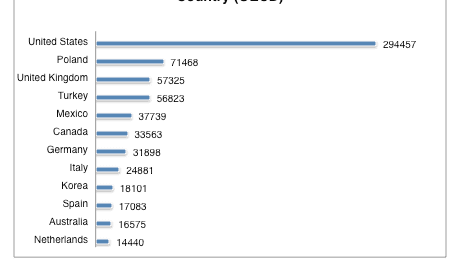
Data published on OECD.Stats Extracts gives an overview of the absolute numbers of graduates from tertiary type-A and advanced research programs for all standard fields of education. According to the International Standard Classification of Education (ISCED), economics and economic history fall under the category of Social and Behavioral Science (business and related disciplines are not included). The graph presented above includes aggregated data for countries with the largest number of graduates in social and behavioral science* for the year 2010. The number of graduates from the US significantly out numbers graduates from other OECD countries, leading in every other discipline as well. Unfortunately, there is no information available on the exact percentage of economists among the graduates.
*Social and Behavioral Science include: Economics, economic history, political science, sociology, demography, anthropology (except physical anthropology), ethnology, futurology, psychology, geography (except physical geography), peace and conflict studies, human rights.
-
- PhD Program, Program, PhD Candidate Job
- Posted 4 days ago
PhD in Economics at BI Norwegian Business School
At BI Norwegian Business School in Oslo, Norway
-
- PhD Program
- Posted 1 day ago
PhD in Economics and PhD in Finance at Durham University
Starts 1 Oct at Durham University in Durham, United Kingdom
-
- Professional Training Course, Supplementary Course, Online Course
- (Online)
- Posted 4 days ago
Spatial Cross-Sectional Econometrics Using Stata
Starts 2 Nov at TStat Training
Currently trending in United States



Related Items



Featured Announcements


Upcoming Deadlines
- Oct 09, 2026
- Oct 12, 2026
- Oct 12, 2026
- Oct 12, 2026
- Oct 14, 2026

