









Student Support
Creating Better Support: Economics Students’ Recommendations for Success
Read a summary using the INOMICS AI tool
In many UK universities, students’ first-year grades do not contribute to their final degree classification. The first year provides a critical period of transition, shaping students’ confidence, help-seeking behaviours, sense of belonging and engagement with their subject and university life. Student support is an important pillar of this foundation, and students’ voices are important in creating the right type of support.
Research shows that unclear or fragmented support structures in higher education increase cognitive load and can disproportionately affect students from underrepresented backgrounds. This has implications for progression, attainment and continuation (de Henau, 2024; Sweller, 2024; Strayhorn, 2021; Thomas, 2012). In this context, effective support provision depends not only on availability, but on clarity, accessibility, and how easily students can navigate systems in practice.
To investigate this, I carried out focus group discussions with students towards the end of the first-year of their degree. Students shared their views on the current support offered and how this could be better tailored to meet their diverse needs. The recommendations presented below were constructed using inductive thematic analysis and are grounded in students’ views and perspectives, illustrated through direct quotes. While student insights form the foundation of the analysis, the recommendations do not simply represent direct student proposals. Instead, they reflect analytically developed responses to recurring barriers identified in the data, informed by evidence-based practice in student support and inclusive curriculum design (de Henau, 2024; Biggs and Tang, 2015; Thomas, 2012). The recommendations aim to improve the visibility, accessibility and effectiveness of student support. The findings are particularly relevant within the context of increasing sector-wide attention on student belonging, continuation, attainment and inclusive educational practices.
Top five actionable suggestions from focus group discussions
These findings build on complementary work examining barriers to student engagement with economics support schemes, which provides additional context on why students do not always make use of available support (Williams Higgins, 2026).
1. Use a centralised dashboard: a single hub outlining all schemes, their purpose and access details.
Many first-year students are unsure of the purpose for each type of support they are offered. This is complicated by the fact that these are usually introduced during the induction/welcome week when students are presented with a large volume of information. Even at the end of the academic year, some students were still unclear or held misconceptions on the student support available.
Students suggested that posting session timings on platforms that students regularly use – such as Blackboard or other virtual learning environments (VLEs) – would reinforce visibility and awareness. Email fatigue meant that they missed out on some resources.
Students also reported that a mid-term/later reintroduction of support schemes was helpful. Reintroduction means that once students are more settled in the university the information becomes more relevant and its purpose more apparent.
“Maybe having the timings of the different support sessions posted on Blackboard or the check-in app, somewhere everyone can see often, so you're constantly reminded. Mainly I get the info from emails, but we already get so many, so it's not a priority. I just tend to forget I can access this kind of resource.”
“Yeah, I think it did take a bit of time to absorb all the different resources that we have to offer, like deciding which one to actually go to and which one use, especially for like the [peer-led] sessions. I didn't really realise it was a thing until a few months into university.”
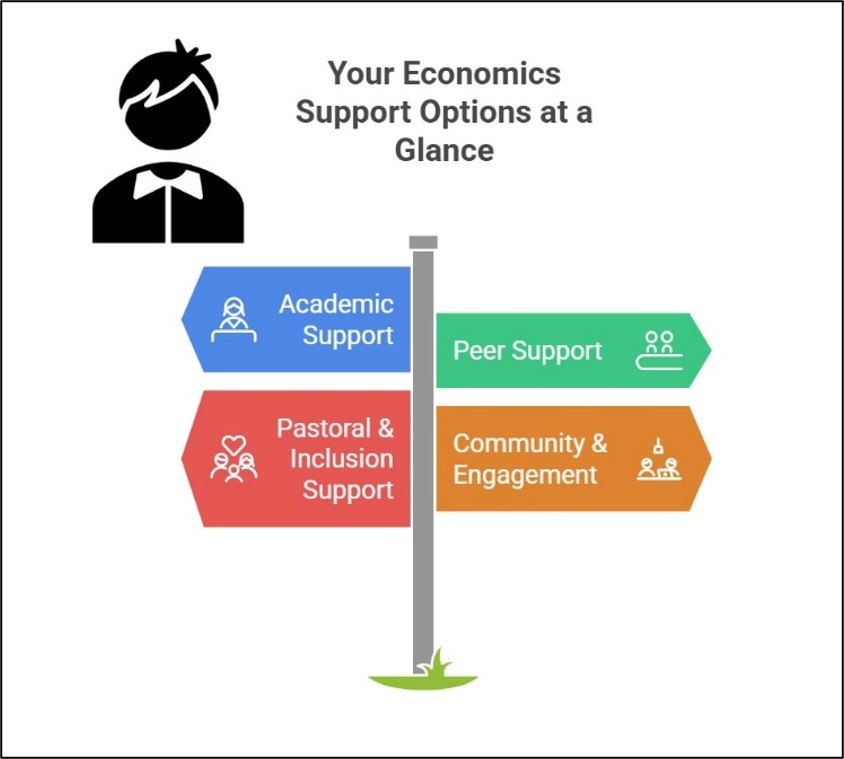
Using a support map is one low-cost and practical way to address this issue (see Figure 1). Support maps are a quick visual introduction to the options for student support and can be used by all university staff when assisting students. What’s more, these do not require all staff to have detailed knowledge of all the support available.
This approach is grounded in evidence that shows how embedded, clearly navigable support structures reduce cognitive load and strengthen belonging and progression, particularly for students from under‑represented backgrounds (de Henau, 2024; Sweller, 2024; Strayhorn, 2021).
Figure 1: Example of a student support map categorising key support options
Source: Author-generated using Napkin AI
It is also important to include the relevant first point of contact for university support in communication with students. That is, where students should go if they are confused. Usually, students talk to the first person they see or the person who they are most comfortable with, often their lecturer or a tutor. Using a support map is one way to ensure that all student facing staff have enough information to signpost and that a consistent message is being shared.
Building on these findings, I recommend implementing a centralised dashboard, supported by a visual support map, to improve clarity, navigation and consistency in how support is communicated and accessed.
2. Incorporate flexible scheduling/hybrid formats: rotate times; offer online and in-person options; mix drop-in/bookable.
When providing services, flexibility is key. Students suggested rotating times for some optional services. Office hours, while seen by institutions as a key resource are usually underutilised and research highlights a mismatch between institutional intention for office hours and student perceptions of them as the last resort in an academic crisis (Smith et al., 2017).
Students also highlighted that office hours can clash with core units and at times, tutors’ office hours coincided with lectures for the same unit. As office hours can be seen as daunting, having such additional barriers can increase the likelihood of them being unused.
“I don't really use the other ones, mainly because they're not convenient and they clash with other things that I'm doing...”
“I think sometimes some of the support comes at the same time as I'm having another lesson… if they were maybe set at different times, I might go more.”
Where possible, I recommend offering online and in-person options. For some students attending in-person requires significant time commitments and may be costly depending on where they live.
3. Provide prep guidance to reduce intimidation: help students to prepare for office hours and other sessions.
Where there are many different types of support, students may be unsure where to seek help for specific issues or how to approach the support sessions available. As a result, they may not attend sessions to avoid looking foolish. Students highlighted this uncertainty, noting:
“...maybe at the start of the [year] if you were told exactly like what the intended use are for each of the sessions, it would be a better way of knowing when you have a specific problem which one to use.”
“I thought you only go [to office hours] if you have really big questions, but I realised, oh, even if it's like something small, at least I can still just go and ask because it's better to ask, like, rather than like, you know, you just sit in the darkness and you just think that you kind of know it. So I think it was also only because in [the spring term], my lecturer pushed us to use more office hours and just ask more questions. A lot of it, I think, was like a lot of people were just quite intimidated. Yeah, me included.”
This is backed up by research that shows that students often state they have no idea what office hours are for (Smith et al., 2017).
Given this context, I recommend that departments and schools implement clear guidance on how to approach the sessions as a part of standard support provision. This guidance should include the goal or intended use of the session and examples of appropriate questions. It should be delivered using a variety of media to ensure accessibility and consistency across the student cohort.
4. Enhance communication strategies: repeat key messages; promote via teaching staff; concise digests over multiple emails.
Students are presented with a lot of information, as well has having coursework and deadlines. To avoid important details being lost along the way, students have indicated that when it comes to support schemes, staggered communication is effective. When they are re-introduced to a support scheme, once they are more settled in their course, they are more likely to remember, see the value of the scheme, and may even engage with it.
“[The peer scheme] and [drop-in] café, I think they did do introductions as well in September… the fact they came in maybe one month later, to explain what they were for, that definitely helped a lot more. Because I think in the first few weeks of starting school, you're just learning new content…that's why I feel like I didn't really know about these sessions that much until they came back later.”
One way to increase student engagement with support schemes is to embed reminders into their lectures and seminars/small group classes. Students highlighted that their use of office hours and discussion boards increased when their use was promoted and encouraged by their teaching team.
Students called for a reduced reliance on emails, due to email fatigue (see point 1). Some would prefer having all support information published in one place:
“I think just maybe like a singular blackboard post with each singular method of the kind of extra support you can get, because obviously it's all on blackboard, but it's all kind of in different places.. But I think that would maybe make it clearer than kind of just in welcome week. Each thing being advertised in things, because obviously with Blackboard there's the permanence about it, like it's always there on a singular post.”
Concise weekly digests from programme teams and student support services could reduce fatigue and improve recall. This could be implemented through existing communications channels without requiring additional resource investment.
5. Streamline overlapping schemes: consolidate similar initiatives to reduce confusion and choice overload.
Reducing and streamlining support options may be more effective to reduce duplication and overload. Where there are multiple options, it is important to be clear about their purpose (as discussed in point 1).
“I feel like… it’s not clear how [the peer session] is different to office hours, [drop-in] café, or Q&A sessions… they seem to overlap in their functionality… I wouldn’t know what questions are better suited to one rather than the other… they’re kind of an undifferentiated block… if you were told exactly what the intended use is for each, it would be easier to know which one to use.”
Nevertheless, having some variety is important to meet the needs of students with different learning styles, as well as the diversity of the student body in general. Students have suggested that instead of relying on office hours for example, instructors could consider adding an additional lecture or review session for complex modules or to provide assessment support. Such an approach can provide more even access to support and reduce the large number of students seeking support at peak times, which can result in increased staffing pressures and reduced access for students due to timing and capacity constraints.
Discussion
Effective student support requires more than just services. The focus groups highlight several important dynamics.
First, there is a tension between the availability of multiple support options and students’ ability to navigate them effectively. Second, confidence and perception barriers influence engagement, particularly with resources such as office hours. Third, students rely on relational and contextual cues, such as encouragement from teaching staff, in deciding whether to access support. Finally, there is a mismatch between institutional assumptions and students’ lived experiences of navigating support systems.
Taken together, the recommendations operate at different levels of implementation. Low-cost quick wins include support maps, clearer signposting, repeated communication, and guidance on how to use support services. Medium-term structural improvements include better timetable coordination, greater use of hybrid provision, and review of overlapping support schemes. At a strategic level, the findings suggest the importance of designing support systems that are not only comprehensive but also simple to navigate and inclusive by design.
These approaches are particularly important from an inclusion perspective, as students from different educational backgrounds may interpret and use support differently, reinforcing the need for clarity, explicit guidance and accessible structures (Thomas, 2012; Lea and Street, 2006). For example, commuting students may benefit from hybrid and flexible provision, first-generation students may require clearer guidance about available support and how to access it, and students entering higher education through different educational pathways may have different expectations of when and how support should be used.
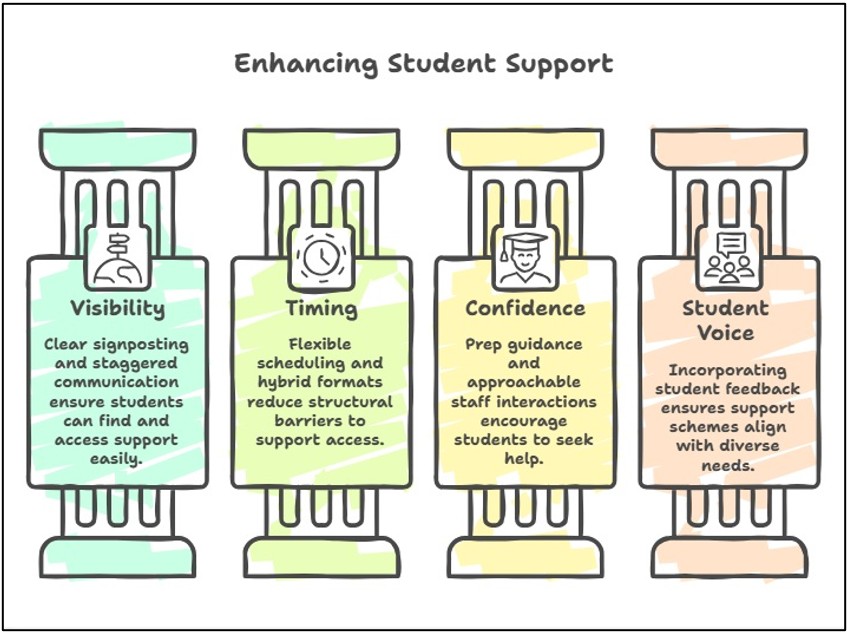
In summary, effective support schemes are visible, well-timed, strengthen student confidence and incorporate the student voice (Figure 2).
Figure 2: Key dimensions of effective student support: visibility, timing, confidence, and student voice
Source: Author-generated using Napkin AI
It is very important to note that providing a range of resources will mean that not all students will use all of the resources. As a result, student engagement should be considered across the range of available resources, rather than through the uptake of any single support scheme, to more accurately assess overall engagement patterns. This highlights the importance of evaluating support systems holistically, recognising that effective provision depends not only on the quantity of support available but also on how easily students can identify, access and use the support most relevant to their needs.
Ethics Approval
This study received ethical approval from the University of Bristol School of Economics Research Ethics Committee. All participants provided informed consent prior to taking part in the research, including specific consent for anonymised quotations to be used in publications and other research outputs. Procedures were implemented to ensure anonymity, confidentiality and the right to withdraw. Data were stored securely in accordance with University of Bristol data protection policies.
References
Biggs, J. and Tang, C., 2015. Constructive alignment: An outcomes-based approach to teaching anatomy. In Teaching anatomy: A practical guide (pp. 31-38). Cham: Springer International Publishing. https://doi.org/10.1007/978-3-319-08930-0_4
de Henau, J., 2024. The impact of academic skills development on student outcomes in higher education–Literature review. Academic Skills Development Project. University of Oxford. Literature Review| Centre for Teaching and Learning. Available at: https://www.ctl.ox.ac.uk/sites/default/files/ctl/documents/media/academic_skills_literature_review.pdf
Lea, M.R. and Street, B.V., 2006. The" academic literacies" model: Theory and applications. Theory into practice, 45(4), pp.368-377. Available at: https://www.tandfonline.com/doi/abs/10.1207/s15430421tip4504_11
Smith, M., Chen, Y., Berndtson, R., Burson, K.M. and Griffin, W., 2017. " Office Hours Are Kind of Weird": Reclaiming a Resource to Foster Student-Faculty Interaction. InSight: A Journal of Scholarly Teaching, 12, pp.14-29. Available at: https://eric.ed.gov/?id=EJ1152098
Strayhorn, T.L., 2021. Exploring ethnic minority first-year college students’ well-being and sense of belonging: A qualitative investigation of a brief intervention. American Journal of Qualitative Research, 6(1), pp.42-58. Available at: https://doi.org/10.29333/ajqr/11422
Sweller, J., 2024. Cognitive load theory and individual differences. Learning and Individual Differences, 110, p.102423. Available at: https://doi.org/10.1016/j.lindif.2024.102423
Thomas, L., 2012. Building student engagement and belonging in Higher Education at a time of change: a summary of findings and recommendations from the What Works? Student Retention & Success programme. Higher Education Academy. Available at: https://www.advance-he.ac.uk/knowledge-hub/building-student-engagement-and-belonging-higher-education-time-change-summary
Williams Higgins, M., 2026. Barriers to Student Engagement with Economics Support Schemes: Insights from First Year Students. Ideas Bank, the Economics Network. https://doi.org/10.53593/n4501a
Image Credits: Melisa Williams Higgins / Economics Network
This article was produced in cooperation with the Economics Network, the largest and longest-established academic organisation devoted to improving the teaching and learning of economics in higher education. Learn more about the Economics Network here.
-
- Postgraduate Scholarship
- Posted 1 week ago
2026 Scholarships in Economics in memory of Fanno, Crivelli and Saccomanni
at UniCredit Foundation in Milan, Italia
-
- Postdoc Job
- (Hybrid)
- Posted 1 week ago
Postdoctoral Position in Applied Microeconomics
At Department of Economics, University of Mannheim in Mannheim, Germania -
- Postdoc Job
- Posted 2 days ago
Postdoc (m/w/d) mit dem Schwerpunkt Arbeitsmarktökonomik
At RWI – Leibniz-Institut für Wirtschaftsforschung in Essen, Germania
Currently trending in Stati Uniti


Related Items



Featured Announcements


Prossime Scadenze
- Ott 27, 2026
- Ott 30, 2026
- Ott 31, 2026
- Nov 01, 2026
- Nov 01, 2026

